
What Is a Certificate of Analysis?
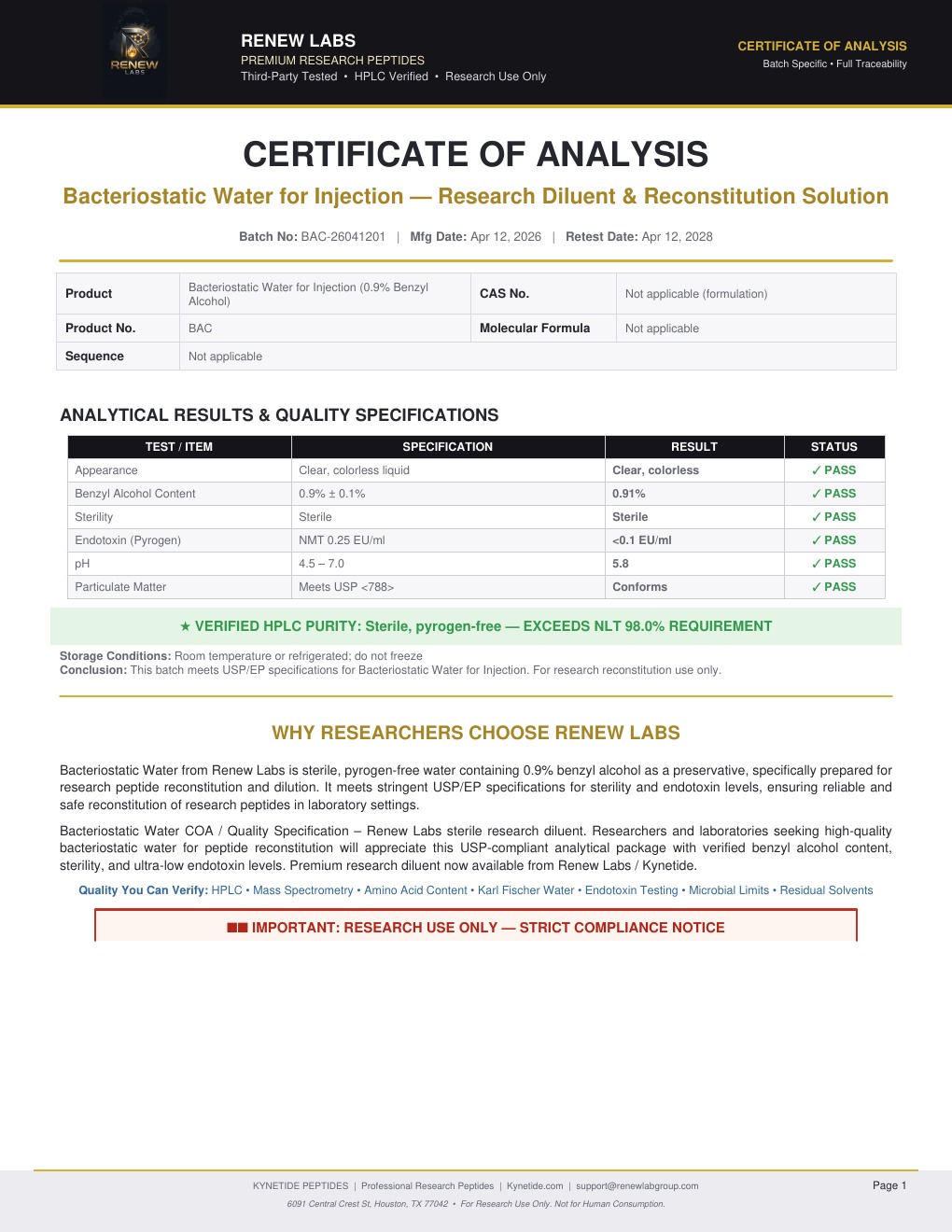
A Certificate of Analysis (COA) is a batch-specific quality document issued by the manufacturer confirming that a product has been tested and meets defined specifications. For bacteriostatic water, a COA verifies benzyl alcohol concentration, pH, HPLC purity, endotoxin levels, and sterility for a specific production batch. It is the primary documentation of product quality for research and pharmaceutical applications.
What Should a Bacteriostatic Water COA Include?
A complete, batch-specific COA for bacteriostatic water should include: the batch or lot number, testing date, HPLC purity result showing benzyl alcohol concentration (0.9% confirmed), pH measurement (4.5–7.0), LAL endotoxin test result (below 0.1 EU/mL for injectable quality), sterility test result, and the manufacturing date and beyond-use date. Generic, undated, or non-batch-specific certificates are not adequate documentation for research use.
Batch-Level vs Lot-Level Testing: The Critical Difference
Lot-level testing means one sample from a large production run is tested to certify the entire lot. Batch-level testing means every individual manufacturing batch — often much smaller than a lot — is independently tested before any of it ships. Renew Lab Group tests every batch at the batch level, not just at lot level. This means your COA reflects the analytical results of the exact product in your vial, not a statistical representative sample.
What Is HPLC and Why Does It Matter on a COA?
HPLC (High-Performance Liquid Chromatography) is an analytical chemistry technique that separates and quantifies the components of a solution. On a bacteriostatic water COA, the HPLC result confirms the exact benzyl alcohol concentration — proving that the 0.9% specification is met. Without HPLC data, a supplier cannot analytically verify concentration; they can only claim it. HPLC is the gold standard for this confirmation.
What Is Endotoxin Testing (LAL)?
LAL (Limulus Amebocyte Lysate) testing is the method used to detect and quantify bacterial endotoxins (pyrogens) in pharmaceutical-grade water products. For injectable quality, endotoxin levels must be below 0.1 EU/mL. Renew Lab Group conducts LAL testing on every batch and documents the result on the COA. Endotoxins are invisible to the naked eye and undetectable without testing — making documented LAL results essential for research integrity.
How to Read Your Renew Lab Group COA
Your COA arrives with every Renew Lab Group order. It shows: the batch number (matches your vial), HPLC chromatogram with benzyl alcohol peak and concentration confirmation, pH result, LAL endotoxin result, sterility status, manufacturing date, and expiration date. If you have questions about any value on your COA, contact our team for interpretation guidance.
Written by
Naomi Crabtree
Quality Assurance Specialist & Research Consultant · Renew Lab Group
Naomi specializes in pharmaceutical quality assurance, HPLC analysis, and USP compendial testing. She oversees Certificate of Analysis verification and research compliance for Renew Lab Group’s bacteriostatic water products.